URA Master Plan · Singapore Property Planning
URA Wants More Homes Around Upper Changi. One Plot Goes From About 350 Flats to 600
Buyers ask whether a home is near an MRT, in a good school zone, and whether the view is blocked. Almost nobody asks the fourth question: what else can be built here. In Upper Changi, URA just published the answer.
 Isaac Lee · PropNex Realty · Updated Sep 2026
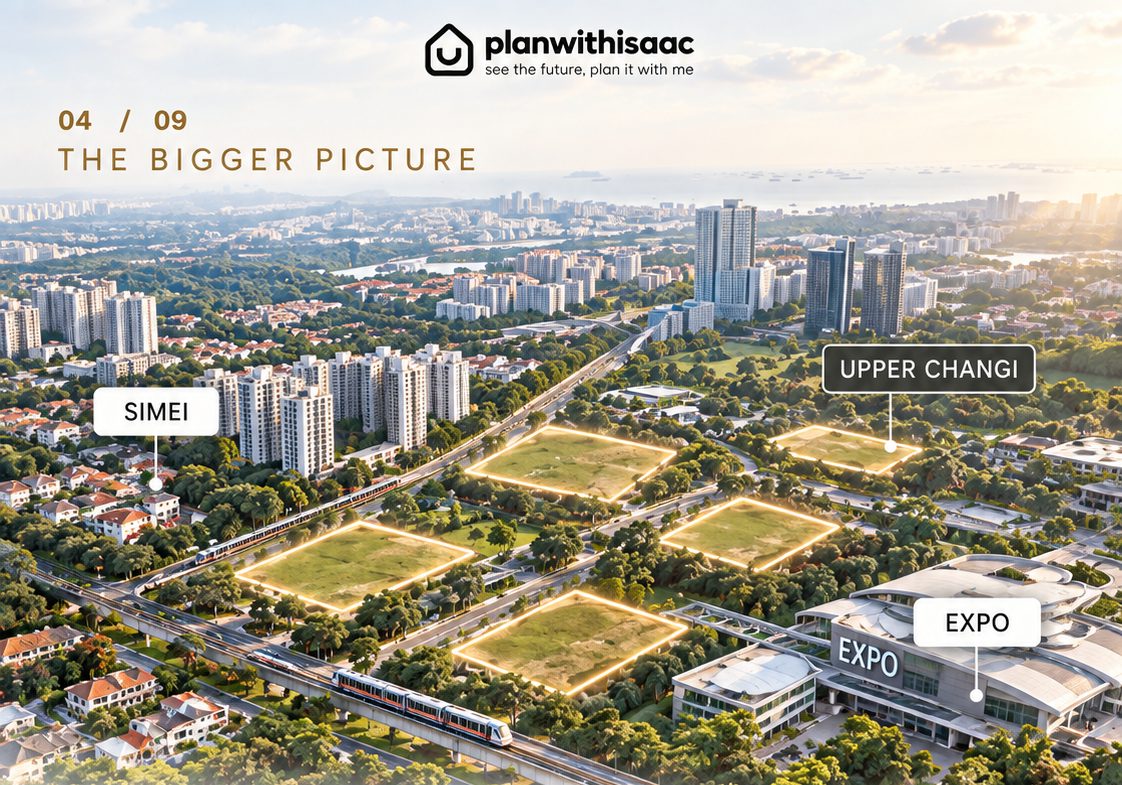
On 18 September 2026, URA published proposed amendments to the Master Plan that raise the gross plot ratio on three plots of land around Upper Changi, close to Expo and Simei MRT stations. URA’s stated reason for each one is the same: to optimise the provision of housing given the site’s proximity to MRT infrastructure.
No building has been announced. No tender has been called. What has changed is the ceiling on what could be built there, and that is information you can act on years before a hoarding goes up.
What URA actually proposed
All three fall within areas URA identified back in 2022 as possible sites for public housing, as part of mixing housing types so residents of different backgrounds live closer together. So the likely product here is public rather than private, which matters for how you read the competition.
What a plot ratio actually is
Gross plot ratio is the maximum gross floor area you may build, divided by the site area. It is a floor-area rule, not a height rule.
Work it through on the largest plot. Two hectares is 20,000 square metres. At a plot ratio of 2.1 you may build about 42,000 square metres of gross floor area. At 3.5, about 70,000. Divide either figure by an average flat size and you have the rough unit count — which is exactly how you get from 350 homes to 600 without the land changing at all.
Height is controlled separately, by the building height plan. A higher plot ratio usually means taller, but not always: the same floor area can come as a few tall slabs or more mid-rise blocks, depending on the height control and the site layout.
How to look up the land next to your own home
You do not need an agent for this, and you should not need to trust one. It takes about three minutes.
- Open URA SPACE, the authority’s public map service, and search your address.
- Turn on the Master Plan layer. Each parcel shows a land use colour and a number — that number is the gross plot ratio.
- Click the parcels around you, not just your own. A white or reserve site, or a low-ratio plot beside an MRT station, is headroom waiting to be used.
- Check URA’s amendments to Master Plan page, which lists proposed changes currently on public exhibition. Proposed amendments are open to written representations during the exhibition window.
Do that once for any home you are seriously considering. It is the cheapest piece of due diligence in Singapore property and almost nobody does it.
The plot next to you has a number. Most buyers never look it up.
More homes nearby: bad for owners?
Not automatically, and anyone who tells you otherwise in one direction is selling you something.
The cost. More supply in your precinct means more competing homes when you eventually sell. If the new stock is public housing, it does not compete directly with a private unit for the same buyer, but it does change the feel and the density of the area, and any nearby executive condominium or mass-market private stock competes more directly for the same upgrader pool.
The benefit. More residents support better amenities: retail viability, bus frequency, childcare places, food and beverage that stays open past nine. Precincts that get denser around a station often get more liveable, not less. Density near an MRT station is also the version of density that works — the alternative is the same homes built further out with worse transport.
A higher plot ratio does not guarantee the final number of homes. It guarantees the possibility.
Four checks before you buy nearby
- Future supply. Count every plot within about a kilometre that has headroom or a pending amendment. One is noise. Five is a pipeline.
- Timing. Rezoning, tender, construction and completion is typically the better part of a decade. Line that up against your own holding period. If the new supply lands after you plan to sell, it is someone else’s problem.
- Product type. Public, executive condominium or private makes all the difference to whether the new homes compete with yours or simply sit beside them.
- Entry premium. If you are being asked to pay a scarcity premium for a quiet, low-density pocket, check whether the pocket is about to stop being low-density.

Remember that this is still a proposal
Proposed amendments go through a public exhibition process and can be adjusted or dropped. Even if the plot ratio is confirmed, nothing obliges anyone to build to the ceiling, and the timeline for these particular plots has not been announced.
What the amendment does give you is an earlier look than the launch calendar will ever offer. By the time a project is announced, the price already reflects it. The planning map is where the information is still cheap.
For the same habit applied to the east more broadly, see what the east’s connectivity story does and does not deliver.
Sources: URA proposed amendments to the Master Plan published 18 September 2026, and contemporaneous reporting on the three Upper Changi plots. Plot ratios and yield estimates are as proposed and may change. Figures are as at publication date.
Frequently Asked Questions
What did URA propose for Upper Changi?
In proposed Master Plan amendments published on 18 September 2026, URA raised the gross plot ratio on three plots near Expo and Simei MRT stations, saying the increase would optimise the provision of housing given their proximity to MRT infrastructure. The largest plot, about 2 hectares between Upper Changi Road and Upper Changi Road East and roughly 370m from Expo MRT, goes from a plot ratio of 2.1 to 3.5. A second plot of about 1.8 hectares across Upper Changi Link is also proposed at 3.5, and a third at 3.4.
What does a gross plot ratio of 3.5 mean?
Gross plot ratio is the maximum gross floor area permitted on a site divided by the site area. A 2-hectare site is 20,000 square metres, so at a plot ratio of 2.1 about 42,000 square metres of floor area may be built, and at 3.5 about 70,000. That is why the largest Upper Changi plot moves from roughly 350 homes to as many as 600. Plot ratio controls floor area, not height; building height is set separately by the height control plan.
How do I check the plot ratio of land near my home?
Use URA SPACE, the public map service. Search your address, switch on the Master Plan layer, and read the number shown on each parcel, which is its gross plot ratio. Click the parcels around you rather than only your own, since vacant or low-ratio land beside an MRT station is where future supply is most likely. URA also publishes proposed amendments to the Master Plan, which are open to written representations while they are on public exhibition.
Will more homes in Upper Changi lower property prices there?
Not automatically. More supply means more competing homes when you eventually sell, which matters most if the new stock is the same product type as yours. But more residents also support better retail, transport frequency and amenities, and density concentrated near an MRT station tends to improve a precinct rather than degrade it. The three Upper Changi plots sit in areas earmarked for possible public housing, which competes less directly with private units than another private launch would.
Want to know what can be built next to the home you are considering?
Send me the address and I will pull the Master Plan layer for the surrounding parcels and tell you where the headroom is.
Usually replies within the day · Isaac Lee, PropNex Realty